
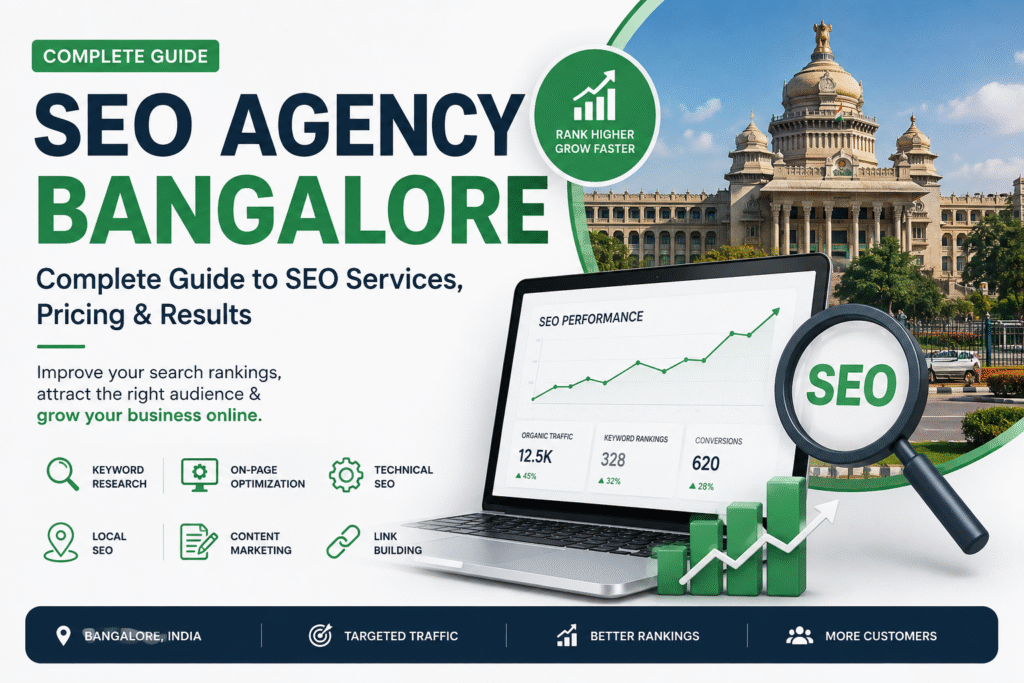
Running a 1. business in Bangalore and wondering why you’re not showing up on Google? You’re not alone. This city is stupidly competitive for search, and if you’re not doing SEO, chances are your competitor down the road already is.
Quick version of what SEO even is: it’s the work of making your website something Google can actually understand and want to show people. Get it right and you start pulling in traffic that doesn’t cost you anything per click, which is a nice contrast to ads, where you’re paying every single time someone shows up whether they buy anything or not.
I put this together because hiring an agency is confusing. You don’t know what a fair price is, what you’re actually paying for, or how long you’re supposed to wait before it works. So here’s the breakdown.
Picture this: you run a small logo design studio. Somebody types “logo design agency near me” into Google. SEO is the entire reason your business shows up on page one instead of getting buried where nobody ever scrolls to.
And that kind of traffic is worth more than it looks. These are people actively looking for what you sell, not someone who clicked an ad by accident. You’re not paying per click either, so once you’re ranking, that traffic just… keeps coming.
Bangalore’s not exactly a sleepy market. Clinics, hotels, tech firms, real estate, salons, restaurants, all of them are scrapping for the same search terms. If you’re sitting this out, somebody else in your space isn’t.
This is where people get confused, because “SEO” sounds like one job when it’s really several stitched together.
Keyword research. Somebody has to figure out what your customers are actually typing into Google, which is not always what you’d guess. A digital marketing agency isn’t chasing huge generic search terms just because they’re popular, they’re going after things like “SEO services Bangalore” that actually convert. Location matters a ton here too. A tree pruning company doesn’t need to rank nationally. They need to rank in their own city, full stop.
On-page stuff. Titles, meta descriptions, headers, URLs, image alt text, internal linking, your calls to action. Sounds technical, but really it’s just making sure your content reads well for a human and makes sense to Google at the same time. Cramming keywords everywhere just makes it unreadable, and honestly Google’s gotten pretty good at sniffing that out anyway.
Technical SEO. The unglamorous, behind-the-curtain work. Page speed, mobile performance, your sitemap, robots.txt, HTTPS, dead links, duplicate content. Nobody gets excited about this part, but if your site’s slow or broken under the hood, none of the content work you’re paying for matters. Google can’t rank a page it can’t crawl properly.
Local SEO. This is what gets you into the map pack and “near me” results. Your Google Business Profile, consistent info across the web, reviews, location-specific pages if you’ve got more than one branch. Someone typing “car wash near me” wants something completely different from someone typing “car wash services,” and this is the part that catches that difference.
Content. Blog posts, guides, FAQs, service pages, comparisons, whatever’s actually useful. More genuinely helpful stuff on your site means more search terms you can realistically show up for. A web design company writing a straight answer to “how much does a website actually cost” isn’t just marketing fluff, it’s answering something people are already googling.
Link building. Other sites linking back to you tells Google you’re worth trusting. This happens through PR, directory listings, resource pages, that kind of thing. But this is exactly where a lot of cheap agencies cut corners, and it backfires. Spammy link farms and paid link schemes can tank your rankings faster than they’ll ever help them.
There’s genuinely no clean number here, and anyone who quotes you a price without asking about your site first is guessing. A five-page site for a local shop is a completely different job from an e-commerce store with a few thousand products.
Roughly speaking though, Bangalore agencies tend to land somewhere between ₹10,000 and ₹1,00,000+ a month, usually monthly or on retainer. What moves that number around:
Your site’s size
How competitive your industry is
How many locations you’re targeting
How many pages actually need work
How much new content the plan involves
How messy things are technically
How aggressive the link building is
What kind of reporting you want
How experienced the agency actually is
Your specific goals
One thing I’ll say plainly: cheap agencies are cheap for a reason. They’re cutting something, and it’s usually the stuff you won’t notice missing until six months in. Don’t ask “how much does this cost.” Ask “what exactly do I get for that?”
Slower than you want, if I’m being honest. This isn’t ads, you don’t flip a switch and see traffic tomorrow. Here’s roughly how it goes:
First couple months: groundwork. Auditing your site, checking out competitors, fixing technical junk, figuring out which keywords are worth chasing.
Months three, four: new content starts going up, old pages get reworked, local SEO gets set up properly, and your site slowly starts building some credibility in Google’s eyes.
Months five, six: usually where you start feeling it. Better rankings, more visibility, and hopefully the phone’s ringing more than it used to.
Past six months: it’s mostly compounding at this point. Doubling down on what’s already working, chasing more keywords, polishing pages that are already pulling traffic.
Take that as a rough shape, not a promise. A brand new site moves differently than one with some history, and a low-competition niche is going to move faster than a crowded one, obviously.
It’s tempting to obsess over stuff like domain authority, but that number doesn’t pay your bills. What actually matters:
Organic traffic
Impressions
Click-through rate
Where you’re ranking for target keywords
Leads and inquiries
Actual sales
Conversion rate
Local visibility, map pack rankings, profile views, that kind of thing
Traffic and impressions tell you people are finding you. Conversions tell you whether it’s the right people finding you. Ranking number one means nothing if nobody who lands on the page actually buys anything.
Depends how big you are, mostly. In-house gives you more control day to day, sure, but you’re paying full salaries to cover technical, content, and link building work that a decent agency already has covered under one roof. For most small and mid-sized businesses, that math just doesn’t work in favor of going in-house.
If you’re a bigger company with the budget to build a real team, then it’s genuinely a toss-up worth thinking through, not an obvious call either way.
What’s the actual plan for my site, not some generic pitch?
How are they picking which keywords to go after?
What are they doing, concretely, each month?
How are they tracking whether it’s working?
What do they report back, and how often?
Can they show real results from actual clients?
What’s their link building approach, specifically?
What happens if the keywords they picked just don’t move?
A good agency answers all of that without flinching. And if anyone promises you page one of Google in a few weeks, walk away. Nobody can guarantee that. Anyone who does either doesn’t know what they’re doing or is banking on you not knowing better.
Somewhere between ₹10,000 and ₹1,00,000+ a month, mostly depending on your site and how competitive your industry is. Local SEO usually runs cheaper than a national push.
Small movement within weeks, sure. Real results, three to six months, longer if your industry’s brutal.
No. Full stop. Anyone claiming they can either doesn’t understand rankings or is telling you what you want to hear.
Yes, arguably more so than for big companies. Local SEO especially levels things out, since ranking in your own neighborhood doesn’t require outspending a national chain.