
You can’t just do SEO once and then forget about it. The information on your competitors’ websites and search engines is always changing, just like the information on your own. To keep and improve your search visibility, you should do an SEO audit on a regular basis.
A digital marketer can use an SEO audit checklist to check a website’s health in a systematic way, find technical issues, check on-page optimization, and come up with ways to boost rankings.
A structured audit approach makes sure that the marketing teams in charge of websites, landing pages, and digital campaigns don’t miss anything important that could hurt search performance.
In this lesson, we’ll go over a full list of things to check for SEO. It will tell you what you need to do to get more people to your website and make it work better in search engines.
An SEO audit looks at how well a website can be found in search results. It means checking the quality of the content, the technical setup, the on-page SEO, and the profiles of the links that point to the site.
The main purpose of an SEO audit is to find issues that could keep a website from showing up high in search results.
A good SEO audit checklist usually includes the following: Issues with technical SEO: the layout of the site and how easy it is for search engines to crawl it, and SEO optimization on the page. The content’s quality and how the keywords are used, the profile of backlinks, how well it works, and how simple it is to use.
By doing these things, marketers can get better search engine results and more traffic from people who find their sites naturally.
If a website doesn’t have a planned SEO audit checklist, it might have hidden problems that hurt its search performance over time.
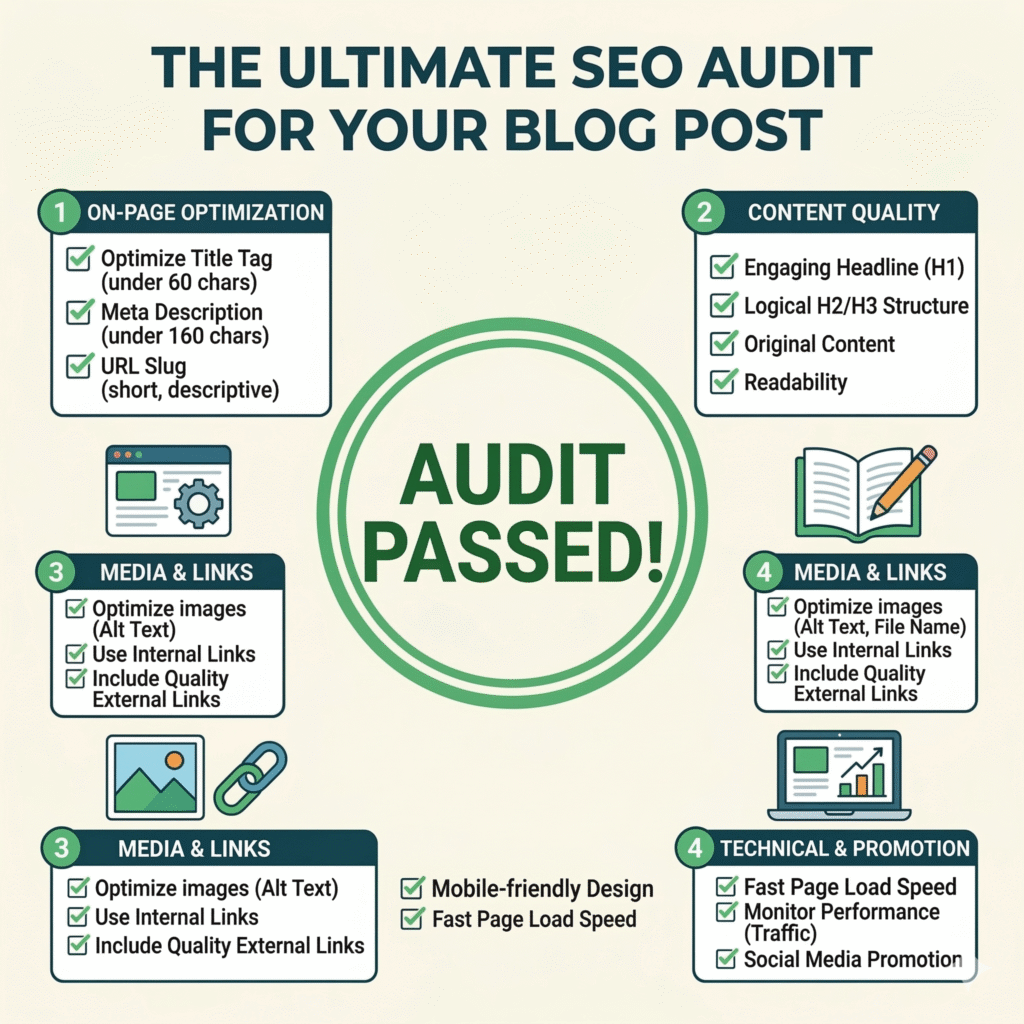
An SEO audit can help find problems that make it hard for search engines to find a website. It lets digital marketers look at the quality of the content, the technical performance, and the overall user experience. Regular SEO audits make sure that your website stays optimized for search engines and keeps getting traffic from search engines. An SEO audit should look at the following important areas for every digital marketing team.
1. SEO for technical reasons
Website Crawlability: Make sure search engines can easily crawl your site by looking at the robots.txt file and the way your site links to itself.
XML Sitemap: A well-organized sitemap helps search engines find and index important pages more quickly.
Technical SEO is what makes a website show up in search results. Even the best content will have a hard time ranking if search engines can’t crawl or index your pages correctly. Speed of the website is also very important. Websites that load faster are easier to use and often show up higher in search results. Page load speed can be greatly improved by optimizing images, speeding up server response time, and getting rid of unnecessary scripts.
2. Improving SEO on Your Page
Tags for Titles: Every page should have its own title tag that includes the main keyword and makes it clear what the page is about.
Meta Descriptions: If you write good meta descriptions that are between 150 and 160 characters long, they can help people click through.
On-page SEO makes sure that every page is set up correctly for both people and search engines. Search engines can better understand the structure of your content if you use headings like H1, H2, and H3 correctly. There should be one H1 heading on each page, and other headings should organize related topics. Content that is well organized is easier to read and helps search engines understand the page better.
3. The quality of the content and how well it uses keywords
Placement of the Main Keyword: The title, introduction, and headings should all have the main keyword in them.
Natural Keyword Distribution: Use keywords in a way that makes sense in the content.
Content is still one of the most important things that affects SEO rankings. Good content should clearly answer users’ questions and give them useful information. Marketers should check to see if the content is correct, useful, and matches what people are looking for during an audit. To stay relevant and improve rankings, you should update content that is old or not very good.
Anchor Text That Matters: Anchor text for internal links should be clear and useful.
Don’t Have Orphan Pages: There should be internal links between every page.
Internal links show search engines how different pages on a website are connected to each other. It also gives different pages more power and makes it easier for users to find their way around. A strong internal linking structure makes sure that important pages get enough link value and are easier for both users and search engines to find.
Quality of Backlinks: Links from trusted sites help your search rankings.
Spam Link Detection: You should find and remove harmful or low-quality backlinks.
Backlinks are still one of the most important signals for search engines when it comes to ranking. During an SEO audit, marketers should look at the number of referring domains, the distribution of anchor text, and the overall authority of the websites that are linking to them. If spam or harmful backlinks are found, the site may need to disavow them to keep its ranking high.
Responsive Design: Websites should work well on all kinds of screens and devices.
Mobile Page Speed: Pages that load quickly make using a mobile device better.
Google uses mobile-first indexing, which means that it mostly looks at the mobile version of a website when deciding how to rank it. Websites that aren’t mobile-friendly often have trouble showing up in search results. Making sure that text is easy to read, buttons are spaced correctly, and pages load quickly can make a big difference in how well a mobile site works and how well it ranks in search engines.
Bounce Rate: A high bounce rate could mean that the content isn’t relevant or that the user experience isn’t good.
Session Length: Longer sessions usually mean that the content is interesting and useful.
Search engines are using more and more information about how people use websites to judge their quality. Metrics like the clickthrough rate, the amount of time spent on the site, and the number of pages visited per session can help show how useful visitors think the content is. Not only does improving the user experience keep visitors coming back, but it can also help your search rankings over time.
The most important part of a search’s success is technical SEO. On-page SEO makes it easier for search engines to understand content. Content that is high-quality and full of keywords can help your rankings. A website is more trustworthy if it has links to and from other sites. The two most important things that affect a website’s search engine optimization (SEO) are how well it works on mobile devices and how easy it is to use.
Using our SEO Audit Checklist on a regular basis can help businesses grow, get higher search engine rankings, and have a stronger organic presence in digital marketplaces that are hard to compete in.
An SEO audit is a thorough look at a website to find problems that hurt its rankings in search engines. It looks at technical SEO, on-page optimization, content quality, backlinks, and user experience to make the website work better as a whole.
An SEO audit can help find technical problems, missing content, and chances to improve a website’s search engine ranking. Regular audits make sure the website follows the rules set by search engines and stays competitive.
Most digital marketing experts say that you should do an SEO audit every three to six months. But big websites or websites that get updated often may need to be checked more often to keep them running at their best.
Google Analytics, Google Search Console, SEMrush, Ahrefs, Screaming Frog, and PageSpeed Insights are just a few of the tools that make SEO audits easier. These tools help you figure out technical problems, keyword rankings, and how well your website works.
Some of the most important things are how easy it is for search engines to crawl your site, how fast your pages load, how well your site works on mobile devices, how you use keywords, the quality of your content, how you link to other pages on your site, and your backlink profile.