
Let’s be honest: a lot of business owners in India have been there. You may have hired someone or done it yourself, but Google still isn’t giving you the love you thought you would get. The traffic is steady. There aren’t any inquiries coming in. And no one can tell you why.
Most of the time, the problem is a few common SEO mistakes that are working against you in the background. The hard part is that it’s easy to miss these mistakes, especially when you’re busy running your business.
So let’s go over the 10 worst ones, why they hurt, and what you can do about them.
Why Getting SEO Right Actually Matters?
People are looking for you on Google. About 71% of all search clicks go to businesses on the first page. Page two? Very few people get there. When SEO mistakes hurt your rankings, you’re not just losing traffic; you’re also giving your competitors potential customers.
The good news is that most SEO mistakes can be fixed. You don’t have to start over from scratch. You only need to know what’s wrong.
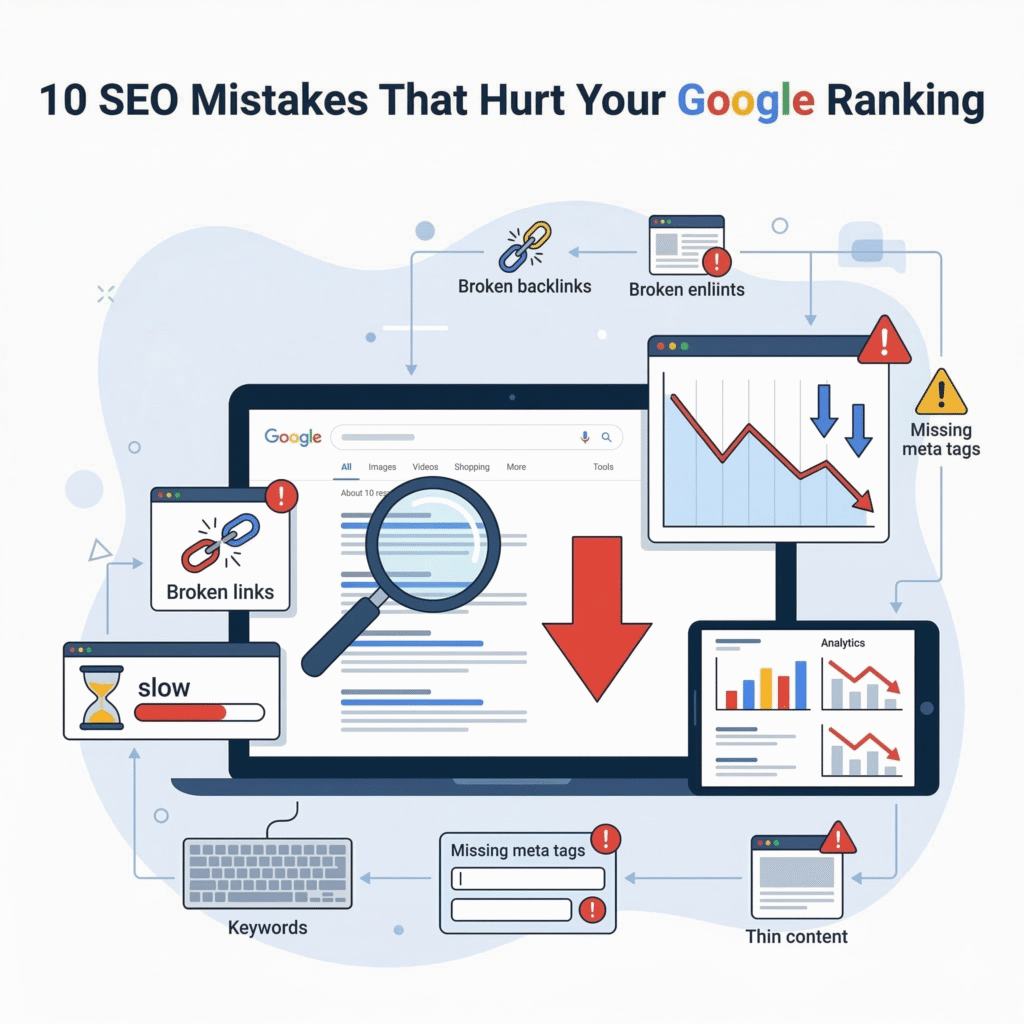
10 SEO Mistakes You Should Fix Right Away
1. Not doing keyword research
Instead of actually checking, a lot of businesses guess what their customers are looking for. The outcome? Pages that use keywords that no one searches for or that are so competitive that they would never rank for them anyway.
Why it hurts: If you use the wrong keywords, good content won’t get any traffic. That’s all there is to it.
Use Google Keyword Planner, Ahrefs, or Semrush to find out what people are really looking for. Put local phrases first. “Accountant in Pune” will always do better than a general “accountant.”
2. Use keywords that are specific to your area smartly.
Some people go too far when they realize that keywords are important. They say the same thing over and over again until the content is unreadable. Google found out about this trick years ago and has been punishing it ever since.
Why it hurts: Unnatural keyword density means bad quality. Your rankings go down, and people leave.
Fix it: Write in a way that sounds natural to real people. Put your keyword in the title, the introduction, and a few headings. After that, just try to be helpful.
3. Poor Website Structure
If your site has confusing navigation, orphaned pages, or no clear hierarchy, Google’s crawlers can’t make sense of it, and neither can your visitors.
Why it hurts: Important pages don’t get crawled or ranked properly. Users get lost and leave.
Fix it: Build a clear path: Home > Category > Page. Every important page should be reachable within three clicks. Use breadcrumbs and clean navigation menus.
4. Slow Loading Speed
53% of mobile users abandon a site that takes more than 3 seconds to load. In India, where most people browse on mobile data, a slow site is a dealbreaker.
Why it hurts: Speed is a direct Google ranking factor. Slow sites rank lower and convert worse.
Fix it: Compress your images, enable browser caching, choose reliable hosting, and use Google PageSpeed Insights to find the specific bottlenecks.
5. Not Being Mobile-Friendly
Since 2019, Google ranks you based on your mobile site first. Over 70% of web traffic in India comes from phones. If your site looks broken on a smartphone, you’re in trouble.
Why it hurts: Poor mobile experience directly lowers your rankings and drives potential customers away.
Fix it: Make sure your site is fully responsive. Test it on Google’s Mobile-Friendly Test tool and address any issues it raises.
People are also using voice search more and more, typing in words like “best doctor near me” to find items. Adding FAQ sections and material in natural language to your website will help it show up in voice search results. 6. Get links from sites in your area
Local backlinks are links from other reputable websites in your area that go to your business’s website. Search engines can tell that your firm is important and trustworthy in the area more easily when you have these links.
You can gain local backlinks by working with local groups, sponsoring events, putting your business on local news websites, or teaming up with other businesses in the region. When powerful local websites link to your website, it makes it more trustworthy and helps it show up higher in local search results.
6. Ignoring Meta Titles and Descriptions
Your meta title and description are your billboard in Google’s search results. Many sites leave them blank, duplicate them across pages, or write them without any keywords.
Why it hurts: Poor meta tags lower your click-through rate, which tells Google your page isn’t worth ranking.
Fix it: Write a unique, keyword-rich meta title (50–60 characters) and description (150–160 characters) for every page. Make them clear and give people a reason to click.
7. Thin or Copied Content
A 200-word page copied from a manufacturer’s website doesn’t impress anyone, especially Google. The Helpful Content updates have made it very clear: quality and originality are non-negotiable.
Why it hurts: Thin content gets de-indexed or buried. It signals that your site isn’t a useful destination.
Fix it: Write original content that fully answers what your reader is looking for. Depth beats length, but don’t cut corners.
8. Ignoring Technical SEO
Broken links, missing sitemaps, pages accidentally blocked from Google, duplicate content issues — these are the silent killers of SEO. They’re easy to overlook and surprisingly common.
Why it hurts: Technical errors can stop Google from indexing your pages entirely. Great content that Google can’t find ranks nowhere.
Fix it: Run a technical audit using Screaming Frog or Google Search Console. Fix 404 errors, submit your XML sitemap, and make sure your key pages are actually being indexed.
9. Not Using Internal Links
Publishing pages without linking them to the rest of your site turns them into islands. Google has a harder time finding and ranking isolated pages, and users can’t navigate to them naturally either.
Why it hurts: Link authority can’t flow through your site, leaving valuable pages under-ranked.
Fix it: Link new content from existing pages and connect blog posts to your service pages. It’s a small habit that compounds over time.
10. Not Tracking SEO Performance
Setting up Google Analytics once and never checking it again is more common than you’d think. Without regular monitoring, you won’t know if rankings are dropping, what content is working, or where new opportunities are appearing.
Why it hurts: You end up repeating what doesn’t work and missing what does. Problems grow unnoticed.
Fix it: Review your organic traffic, keyword rankings, and Search Console alerts every month. Catch issues early before they turn into bigger problems.
Conclusion: Small Fixes Can Make a Big Difference
None of these mistakes are unique to struggling businesses we see them everywhere. What separates the ones that grow from the ones that stagnate is usually just whether someone is paying attention and doing something about it.
You don’t need a perfect website. You just need to start fixing what’s broken.
Frequently Asked Questions
What are the most common SEO mistakes businesses make?
Skipping keyword research, stuffing keywords, having a slow or mobile-unfriendly site, thin content, missing meta tags, and never checking performance data. Any one of these causes problems; together, they can make a website nearly invisible.
How do SEO mistakes affect Google rankings?
Each mistake sends a negative signal to Google — poor experience, weak content, technical errors. Enough of them together and your pages drop significantly, or stop appearing in search results altogether.
How often should I do an SEO audit?
Every six months for a full audit. Monthly for a quick metrics check. And immediately after any major website change, redesigns and migrations can introduce new problems overnight.
Can these mistakes be fixed if they've been there a while?
Most of them, yes. Technical fixes tend to be quick wins. Recovering from a Google penalty or years of thin content takes longer — but it’s absolutely doable with consistent effort.
Is it worth hiring an SEO agency rather than doing it myself?
If SEO isn’t your core skill and your time is better spent running your business, then yes. The cost of getting it wrong in lost traffic and leads usually far outweighs the cost of getting proper help.
